Selling a Home With Solar Panels in Visalia, CA Tulare, CA or Hanford CA

Solar panels have become increasingly common on homes throughout California’s Central Valley. If you are thinking about selling a home with solar panels in Visalia, Tulare, Hanford, Kings County, or Tulare County, it is important to understand how your solar system could affect the transaction.
Selling a house with solar is absolutely possible, but the process can vary depending on whether the panels are owned, financed, leased, or covered by a power purchase agreement. Buyers, lenders, appraisers, escrow officers, and real estate agents may all need information about the system before the sale can move forward.
Preparing the correct solar documents before listing can help prevent confusion, financing problems, and unnecessary delays during escrow.
As a local Central Valley Realtor, I help homeowners understand how features such as solar panels may affect pricing, marketing, buyer interest, and the overall home-selling process. You can learn more about my local real estate experience by visiting Justin Galindo Realtor.
Can You Sell a Home With Solar Panels in California?
Yes, you can sell a California home that has solar panels. However, the steps required will depend on how the solar system was purchased and whether there is an outstanding financial obligation attached to it.
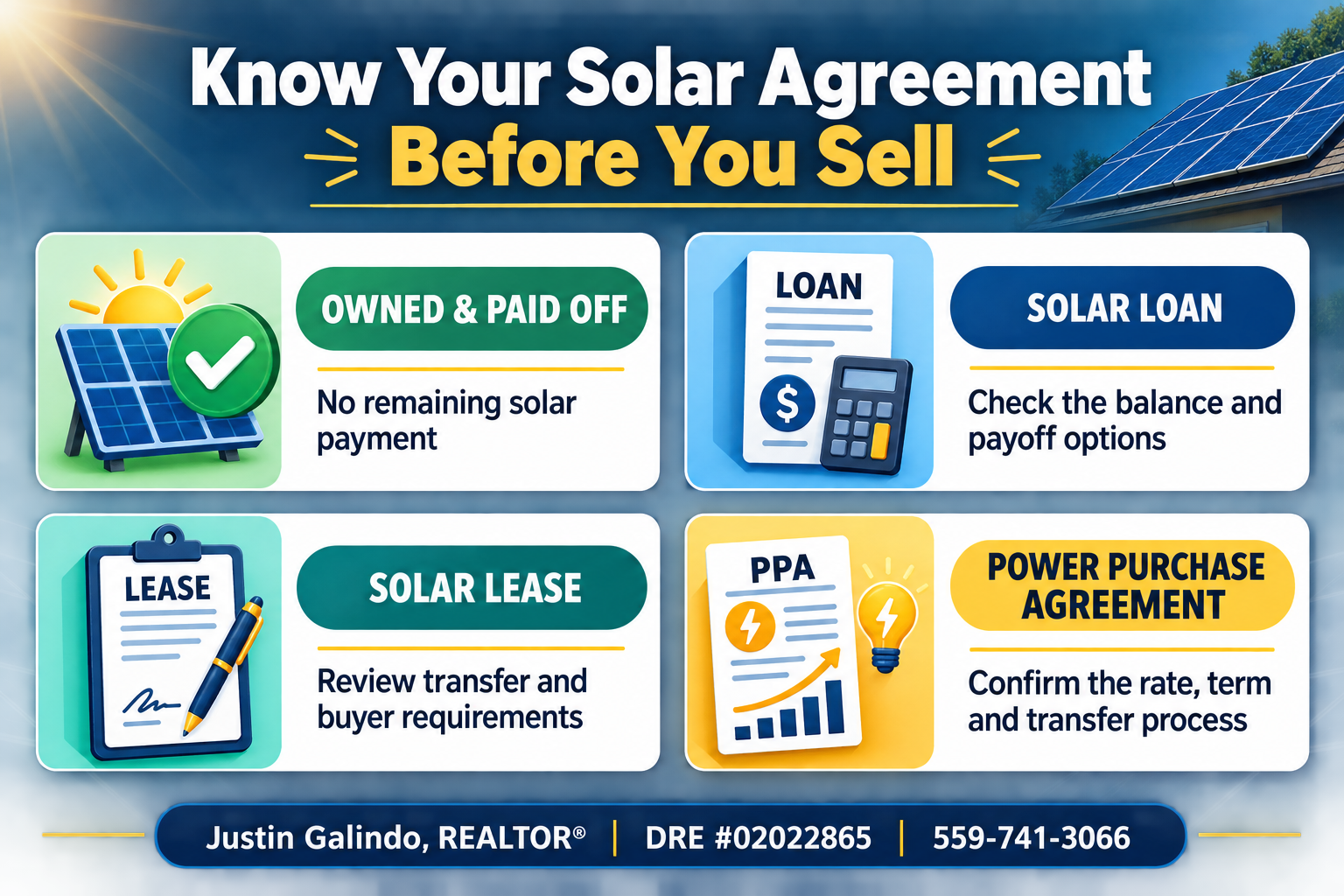
Before putting your home on the market, determine which of the following best describes your system:
The solar panels are completely paid off and owned.
The solar panels were financed and still have a balance.
The solar system is leased from a solar company.
The property is covered by a power purchase agreement, commonly called a PPA.
The solar obligation may be connected to a property tax assessment or another financing arrangement.
Each type of agreement can affect the sale differently. Do not assume that a buyer will automatically take over your solar payment. The solar provider, buyer, lender, and escrow company may need to review and approve the transfer.
Selling a Home With Paid-Off Solar Panels
A paid-off solar system is generally the most straightforward arrangement when selling a home. Because there is no remaining solar loan or lease payment, the system can typically transfer with the property.
Owned solar panels may make a home more appealing to buyers who want energy-efficient features without taking on another monthly payment. However, sellers should be careful about guaranteeing a specific amount of energy savings or claiming that solar automatically adds a certain dollar amount to the property’s value.
A home’s value is influenced by its location, size, condition, upgrades, neighborhood, recent comparable sales, buyer demand, and current market conditions. Solar may be one positive feature, but it is only one part of the complete pricing analysis.
If you are wondering how much your solar-equipped home may be worth, request a free home valuation from Justin Galindo Realtor. I use recent comparable sales and neighborhood-specific information instead of relying only on a generic online estimate.
Selling a Home With Financed Solar Panels
If you financed your solar panels and still owe money, the remaining balance will need to be addressed as part of the sale.
Depending on the financing agreement, you may be able to:
Pay off the remaining solar balance before closing.
Pay off the balance using proceeds from the sale.
Ask the buyer to assume the solar loan if the agreement permits it.
Negotiate another arrangement approved by the solar company, buyer, lender, and escrow.
Loan assumption is not always automatic. The buyer may need to qualify separately with the solar financing company, and the buyer’s mortgage lender may consider the solar payment when reviewing the buyer’s debts and monthly obligations.
This is why sellers should contact their solar provider early. Waiting until the home is already in escrow to locate the solar agreement or request a payoff statement can create avoidable delays.
Selling a Home With Leased Solar Panels
When solar panels are leased, the homeowner generally does not own the equipment. Instead, the homeowner makes payments to a solar company under a lease agreement.
A buyer may be able to assume the lease, but the transfer process is determined by the solar provider and the specific contract. The buyer may need to complete an application, qualify for the lease, agree to the remaining terms, and receive approval before the transfer can be completed.
Some buyers may appreciate the potential energy benefits, while others may be hesitant to accept a long-term solar agreement. Clear communication and complete documentation can help buyers evaluate the system before making a decision.
Before listing a home with leased solar, ask the provider for:
A complete copy of the solar lease
The current monthly payment
The remaining term of the agreement
Information about payment increases, if applicable
Transfer instructions and qualification requirements
Buyout or early payoff options
Contact information for the transfer department
Any fees associated with transferring the agreement
The exact contract matters. Homeowners should review their documents carefully and contact the solar provider directly for information about their particular system.
What Is a Solar Power Purchase Agreement?
A solar power purchase agreement, or PPA, is an arrangement in which a solar company owns the system and the homeowner agrees to purchase the electricity the system produces under the terms of a contract.
Although a PPA is different from a traditional solar lease, it may also require buyer qualification or formal transfer approval. Sellers should request a copy of the agreement, current payment information, transfer requirements, rate details, and any available buyout options before placing the property on the market.
Buyers should be given an opportunity to review the agreement and understand the financial commitment before moving forward with the purchase.
Can Solar Panels Affect a Buyer’s Mortgage Approval?
Solar can affect mortgage approval when the property has an outstanding solar loan, lease payment, PPA obligation, lien, or other financial arrangement.
The buyer’s lender may need to determine:
Who owns the solar equipment
Whether a solar payment must be included in the buyer’s debt calculation
Whether there is a lien or security interest attached to the system
Whether the solar agreement can be transferred
Whether the contract meets the lender’s loan-program requirements
Requirements can differ depending on the buyer’s loan type, lender, solar contract, and financial situation. Sellers should avoid promising that a solar agreement will automatically be accepted by every buyer or lender.
Providing the documents early allows the buyer’s lender, escrow company, and other professionals to evaluate the arrangement before it becomes a last-minute problem.
Do Solar Panels Increase a Home’s Appraised Value?
Solar panels do not automatically increase every home’s appraised value by the original purchase price of the system. An appraiser may consider whether the panels are owned, financed, or leased, along with comparable sales and other market information.
Owned solar and leased solar may be treated differently. The age, condition, capacity, ownership structure, warranties, and local buyer demand for solar-equipped homes may also be relevant.
Sellers should not simply add the remaining solar balance or original installation cost to their desired sales price. A strong listing strategy begins with recent comparable sales and an honest evaluation of how local buyers are responding to similar properties.
My approach to selling homes in Visalia, Tulare County, and Kings County includes local pricing research, professional marketing, clear communication, and a strategy designed specifically for the property.
Documents to Gather Before Listing a Solar Home
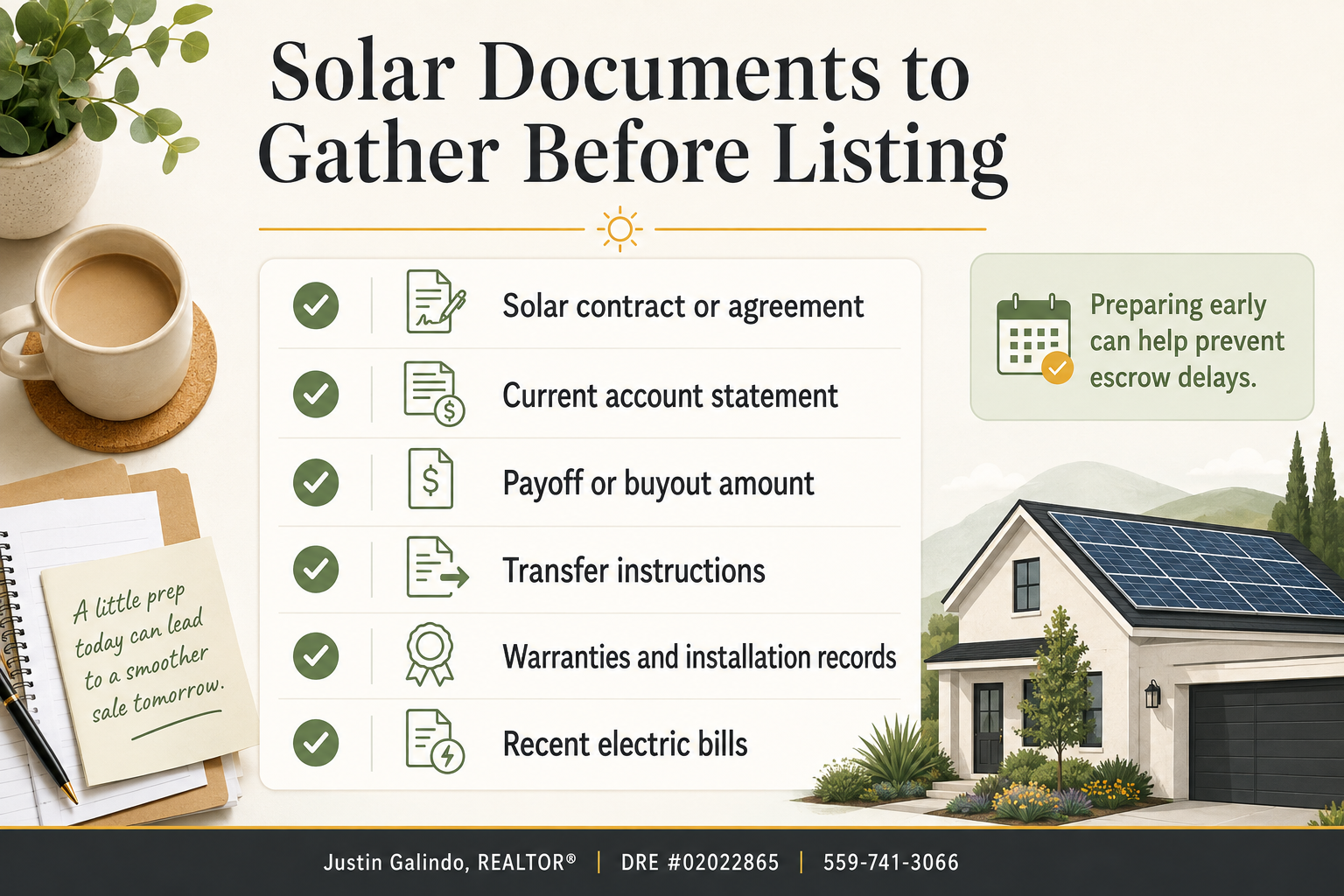
Preparing your solar information before the property goes on the market can make the selling process much smoother.
Try to collect the following documents:
The original solar purchase, financing, lease, or PPA agreement
The latest solar account statement
The current payoff or buyout amount, if applicable
Transfer instructions from the solar provider
Equipment ownership information
Installation records and permits
Manufacturer and installer warranties
Maintenance or repair records
Recent electric bills
Information about system size and installation date
Details about battery storage, if the home has a battery
Contact information for the solar provider’s transfer department
If you cannot locate these documents, contact the solar company as soon as possible. Requesting them before accepting an offer can save valuable time later.
How Should a Home With Solar Be Marketed?
Solar should be marketed accurately and clearly. A listing should explain whether the system is owned, financed, or leased when that information is available and appropriate to disclose.
Depending on the property and documentation, useful marketing details may include:
Owned or paid-off solar
Solar system installation date
Battery backup or energy-storage equipment
Available system warranties
Historical electricity information
Energy-efficient improvements made to the home
Sellers and agents should avoid guaranteeing future electric bills or making unsupported claims about savings, property value, or system performance. Energy use can vary based on household size, temperature preferences, equipment, utility rates, and lifestyle.
Honest marketing can help attract serious buyers while reducing misunderstandings during escrow.
Common Mistakes When Selling a House With Solar
One of the biggest mistakes is waiting until after accepting an offer to investigate the solar agreement. Other common problems include:
Not knowing whether the system is owned, financed, or leased
Assuming the buyer must take over the agreement
Failing to request a current payoff or buyout amount
Advertising financed solar as paid off
Promising a buyer a specific monthly electric bill
Waiting too long to begin the transfer process
Failing to give the buyer and lender enough time to review the documents
Pricing the home based only on what the solar system originally cost
Forgetting to disclose batteries or additional solar equipment
Early preparation can help sellers avoid surprises and give buyers greater confidence in the property.
Should You Pay Off Solar Before Selling Your Home?
Whether paying off solar before closing is the best choice depends on the remaining balance, contract terms, anticipated sale proceeds, buyer demand, transfer requirements, and the seller’s financial goals.
Paying off the system may make the property more attractive to buyers who do not want another payment. However, paying it off in advance may not make sense in every situation.
Before making a decision, request a written payoff or buyout statement and discuss the available options with the appropriate real estate, escrow, solar, lending, tax, and legal professionals. The goal is to understand the numbers before choosing a strategy.
Frequently Asked Questions About Selling a Home With Solar
Is it harder to sell a house with solar panels?
Not necessarily. Paid-off solar can be appealing to buyers. Financed or leased solar can add additional steps because the agreement and transfer requirements must be reviewed. Good preparation and clear documentation can make the transaction easier.
Does a buyer have to assume my solar loan or lease?
Not automatically. Whether the agreement can be assumed depends on the solar contract, provider requirements, buyer qualification, and the buyer’s mortgage lender. Other options may include paying off or buying out the agreement.
Can I use my sale proceeds to pay off the solar balance?
This may be possible depending on the agreement and escrow requirements. Sellers should obtain a written payoff statement and confirm the process with the solar provider and escrow company.
Should I disclose that my home has leased or financed solar?
The solar arrangement is important information for potential buyers. Sellers should provide accurate details and complete all required California real estate disclosures. Consult the appropriate professionals if you have questions about a specific disclosure obligation.
Will solar panels help my home sell for more money?
Solar may make a property more attractive, particularly when the system is owned and paid off, but it does not guarantee a specific price increase. Local comparable sales, condition, location, market demand, and the solar agreement all matter.
When should I contact my solar company?
Contact the provider before listing the home. Ask for the contract, transfer instructions, current payoff or buyout amount, account information, and an estimated transfer timeline.
Work With a Central Valley Realtor Experienced With Solar Homes
Selling a home with solar panels requires more than placing a sign in the yard. The property must be priced correctly, marketed accurately, and supported by documents that allow buyers and lenders to understand the solar arrangement.
I’m Justin Galindo, a Central Valley Realtor serving homeowners throughout Visalia, Tulare, Hanford, Lemoore, Tulare County, Kings County, and surrounding California communities. I help sellers prepare their homes, evaluate comparable sales, develop a pricing strategy, market their properties, review offers, and navigate escrow from beginning to closing.
If you are considering selling a home with owned, financed, or leased solar panels, I can help you begin preparing before the property reaches the market.
Contact Justin Galindo Realtor or call 559-741-3066 to schedule a free, no-pressure home-selling consultation.
Justin Galindo, REALTOR®
California DRE #02022865
Serving Visalia, Tulare County, Kings County and the Central Valley
Phone: 559-741-3066
This article provides general real estate information and is not legal, lending, tax, appraisal, solar, or financial advice. Solar contracts and transfer requirements vary. Homeowners and buyers should review their specific agreements and consult the appropriate qualified professionals.